Why Most Healthcare Practices Lose Revenue — Lost Revenue

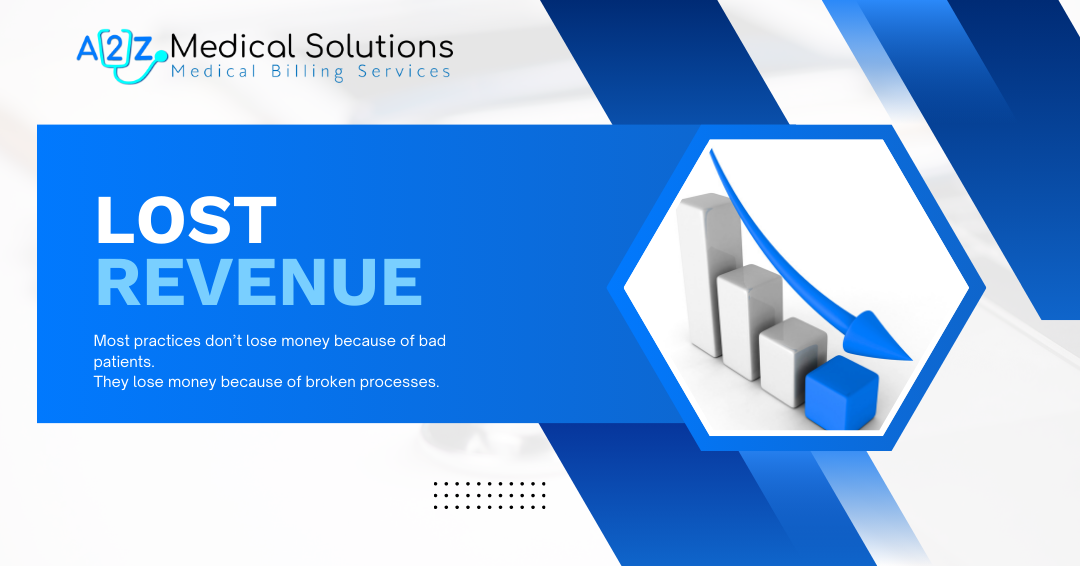
Revenue loss is one of the most silent killers of healthcare practices today. Most physicians are aware they are under-collecting, yet very few know why it happens or how much it is actually costing them annually. In fact, studies show that U.S. medical practices lose 10–30% of total revenue due to avoidable issues in billing, coding, documentation, and follow-up. However, the lost revenue is always recoverable.
What makes this alarming is that these losses are not caused by market conditions — they are caused by internal inefficiencies.
This blog breaks down the real reasons healthcare practices lose money and what they can do to stop it immediately, based on industry experience and the operational framework used at A2Z Medical Solutions to recover Lost Revenue.
1. Lack of Clean Claims (The #1 Reason for Revenue Leakage)
A clean claim is one that is coded, documented, and submitted correctly the first time.
The industry benchmark is 95% clean claim rate, but the average private practice sits between 70–85%. That means:
-
Every rejected claim delays cash flow by 30–60 days
-
Every denial requires 2–3x more labor
-
Some claims never get resubmitted and become permanent revenue loss
Top reasons for unclean claims:
-
Missing or inaccurate patient demographics
-
Incorrect insurance eligibility
-
Wrong CPT/ICD combinations
-
Missing modifiers
-
Poor documentation
-
Lack of internal QA on claims
2. Poor AR Follow-Up and Aging Accounts
Revenue is not earned until it is collected — and this is where most practices fail.
Over 60% of medical practices struggle to keep AR under control. When AR exceeds 120 days, the chance of receiving payment drops to 15% or less.
Symptoms of unhealthy AR:
-
High volume of unpaid claims
-
Neglecting follow-up on denials
-
Allowing claims to reach 60–90+ days
-
Not tracking AR by bucket (0–30, 30–60, etc.)
3. Incorrect Coding or Under-Coding
Coding errors are one of the easiest ways money slips through the cracks.
Many providers unintentionally under-code, thinking it reduces audits. In reality, it reduces revenue by up to 20% per patient visit.
Major coding issues:
-
Under-coding due to fear of overbilling
-
Documentation not supporting billed codes
-
Missing chronic conditions
-
Incorrect use of E/M levels
-
Billers not trained on specialty-specific codes
4. Inefficient Front Desk Operations
Most revenue issues begin before billing even starts.
Front desk issues include:
-
Collecting wrong patient information
-
Not checking insurance eligibility
-
Not verifying coverage changes
-
Skipping pre-authorizations
-
Incomplete documentation
5. Not Tracking Key Metrics (No Visibility = No Control)
Most practices do not track:
-
Clean claim rate
-
First-pass acceptance rate
-
Days in AR
-
Net collection rate
-
Denial rate by category
-
Revenue per encounter
6. Relying on an Overworked Internal Billing Team
An internal biller handles:
-
Coding
-
Eligibility
-
Submissions
-
Denials
-
AR
-
Rejections
-
Patient statements
This is unrealistic and leads to backlogs.
Related posts


Write a Comment
Testimonials
We have been using A2Z Medical Solutions company for our billing for over 10 years and we are very pleased with the services they provide. They have always communicated with us and our patients about any billing or insurance issues that arise and have resolved them promptly. The consistent and timely collection is crucial to run a small business like ours. A2z Medical Solutions has fulfilled that for us. We are very happy with them.

Dr. Abbas A
A2Z Medical Solutions has done an amazing job with our account. Besides billing accurately on a daily basis and doing a timely and detailed follow-up on each unpaid bill, they have tailored their system to help our company manage our clients, employees and payors. The personal touch we receive far exceeds any billing service I’ve used in the past.

Dr. Andrea A
I am very satisfied with your transcription services. Your quick report turnaround time and accuracy have helped us manage patients effortlessly in our multi-discipline practice. It’s amazing that you maintain a consistent turnaround of 24 hours and at the same time manage to keep your rates reasonable.

Joan Palmeiri
A2Z Medical Solutions helped us identify the errors in our billing system that led to delays & losses. Today, we do not worry about internal billing anymore.

Dr. Frankie Kao
They have managed our RCM services with such competency that we have been able to maximize reimbursement year-on-year.

Dr. Doris Jones
Coding and billing for our facility are complex and require constant reviews. Since July of 2017, a2z Medical Solutions has managed our RCM services with such competency that we have been able to maximize reimbursement year-on-year. Thanks to them our net receivables today far outweigh our costs.

Dr. Amy McClure
Dealing with insurance companies was a big headache for us as they were rejecting claims left and right. We then realized that in-house billing would be challenging to maintain. So we outsourced our claims processing to a2z Medical Solutions. Within a few short months claims I thought we would never see, were paid to us. Our revenue has grown so fast that we now commit ourselves completely to MedBillingExperts’s high-quality services.

Dr. Selena Gollet